


16 Oct AHN’s Jefferson Hospital opens donation drop-off site for breast milk
90.5 WESA – When Victoria Meucci gave birth to her third child in August, she arrived at the Jefferson Hospital delivery room with a list of worries. Among them was a gestational diabetes diagnosis and questions about it might impact her newborn daughter.
When little Liliana was born, her blood sugar readings were low. Victoria worried about how best to feed her baby to improve those readings. But her milk supply had not come in yet.
Jefferson Hospital offered her donated breast milk, which has been shown to be an effective supplement for the treatment of such conditions as neonatal hypoglycemia. She said the experience reaffirmed the importance of breast milk banks.
“It showed us just how valuable that resource can be during those first precious days of a baby’s life,” Meucci said. “Sometimes even a small amount of help can make a tremendous difference for a family.”
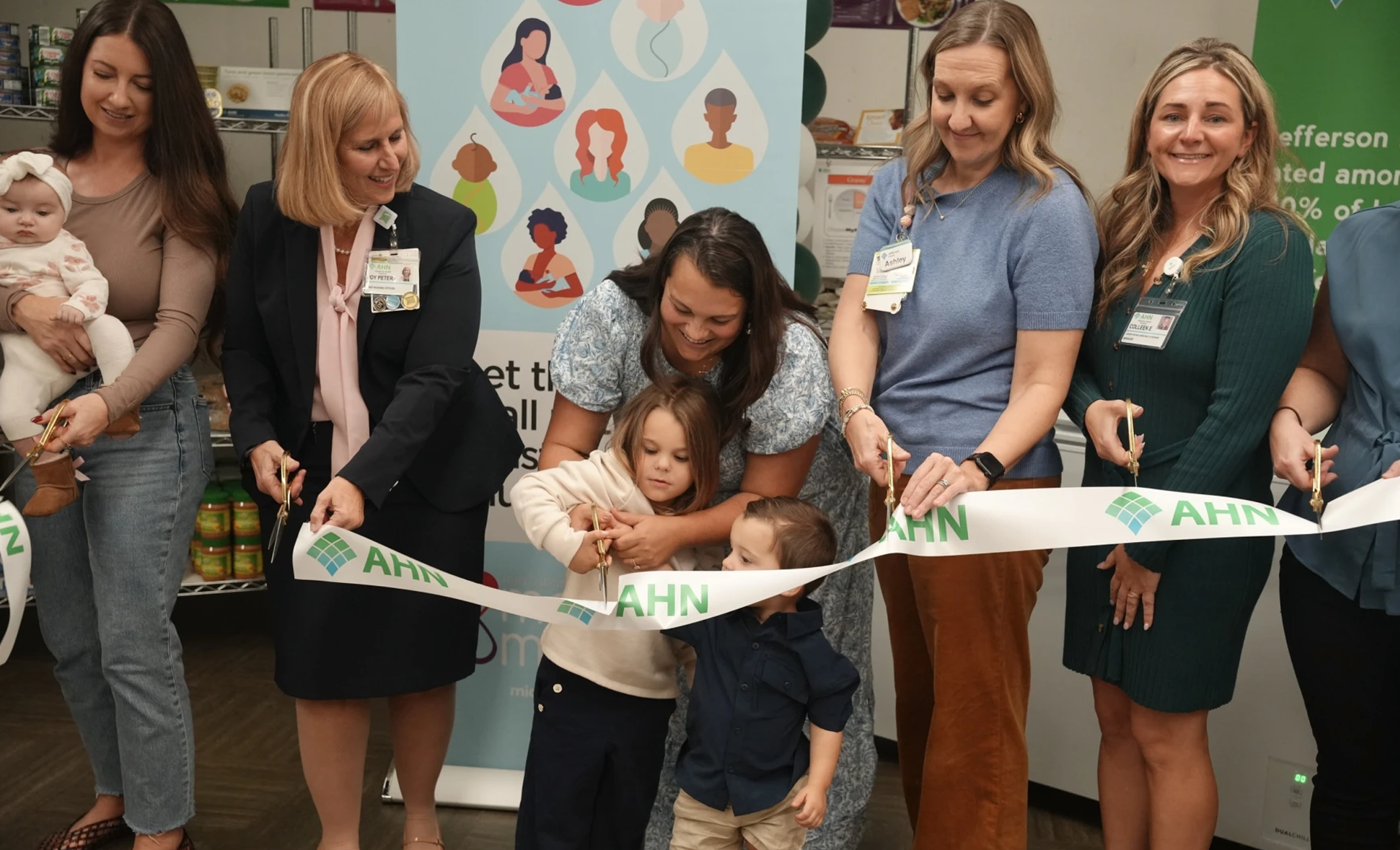
Now Jefferson Hospital is opening the first Milk Bank Depot in the South Hills as part of an ongoing partnership between Allegheny Health Network and the Mid-Atlantic Mothers’ Milk Bank.
A Pittsburgh-based nonprofit, the Mid-Atlantic Mothers’ Milk Bank supplies ethically sourced donor milk for both inpatient and outpatient babies with medical needs in Pennsylvania and West Virginia as well as parts of New Jersey and Maryland. The group is led by physicians, lactation consultants, nurses and parents whose shared goal is equitable access for all babies to safe human breast milk.
Inside AHN Jefferson’s Healthy Food Center, a brand-new freezer chest is already packed with donated breast milk in bags labeled with dates. The milk collected by the hospital will be sent to the Milk Bank lab in the Strip District for testing and pasteurization. The milk bank then distributes the supply to hospitals across the state.
Women and birthing parents with a surplus supply of breast milk can complete a screening process and drop off their milk on Mondays, Wednesdays and Fridays.
The goal is to increase the supply of donor milk in the region, according to Joy Peters, the hospital’s chief nursing officer.
“Breastfeeding journeys look different for every mother and every family. Sometimes additional support is needed, especially for premature babies, medically fragile newborns, or infants whose mothers are facing challenges that temporarily limit their ability to provide breast milk,” Peters said. “That is why access to donor milk is so important.”
At a ribbon-cutting Thursday to mark the opening of the bank, Meucci said she intends to return the favor to another mother by donating her breast milk in the future.
“I hope that someday I’ll have the opportunity to give back by donating my own extra breast milk and helping another family in the same way ours was helped,” she said.
Donor milk plays a critical role in neonatal care units. And as medicine continues to advance, the need for donor milk continues to grow. The Mid-Atlantic Mothers’ Milk Bank operates depots in hospitals across Pennsylvania, West Virginia and in parts of New Jersey. The idea is to eliminate barriers to donating breast milk, something Peters said Jefferson is aiming to achieve.
“This new depot makes it easier for eligible mothers to make an extraordinary gift by donating surplus breast milk,” said Peters. “Their generosity will help babies they may never meet but whose lives can be profoundly impacted.”
Without neighborhood drop-off sites like these, the milk bank accepts boxed shipments of donations, which must be delivered overnight to maintain quality. But overnight delivery is expensive.
At the Jefferson Hospital milk depot, staff will routinely monitor the temperature of the breast milk freezer and coordinate pickup with the milk bank. A courier will deliver the milk supply to the Strip District lab, according to Denise O’Connor, co-founder and executive director of the Mid-Atlantic Mothers’ Milk Bank.
Donors must complete a bloodwork screening for medication and supplement use as well as bloodborne pathogens. When the milk is delivered, the milk bank lab begins the pasteurization process to kill bacteria and viruses that could harm pre-term or medically fragile babies.
“We use a low-temperature process that inactivates those bacteria and viruses, but at the same time keeps all the good stuff,” O’Connor said. “All those bioactive things, the immunological factors and different things that support babies’ growth and development.”
The milk also goes through additional testing after the pasteurization process as a safety precaution. In Allegheny County, the final testing is done at Jefferson Hospital, where the lab also analyzes the macronutrient contents of the milk for neonatal intensive care units.
O’Connor said the Mid-Atlantic Mothers’ Milk Bank has seen explosive growth during the past decade. While donors can still drop off surplus milk at the bank’s small Strip District headquarters, she said hospitals like Jefferson are ideal community locations for busy families.
“That added convenience for the local donors is really making donation far easier and is resulting in more milk for the milk banks,” O’Connor said. “So anything we can do to bring barriers down, the better.”